Blogs

2026-09-24
Choosing the Right Office Cubicle Brand for Modular Interiors
If you're looking at office cubicles for a modular workspace, there's no shortage of brands to choose from. The bigger names — Steelcase, Herman Miller, Haworth, HON, Allsteel, Teknion — get mentioned a lot, but there are also manufacturers like LINRAY that focus more on dealers, contractors, and commercial project buyers.
That said, picking a brand isn't just about going with whichever name sounds most familiar.
Modular office cubicles vary a lot from one company to the next. Some brands are built for large corporate headquarters and high-end offices. Others lean more into design and brand image. And some cubicle manufacturers are simply better suited to projects that need custom sizing, partitions, colors, storage configurations, or bulk ordering.
For companies that shift team sizes and office layouts often, one real advantage of modular cubicles is that they scale with headcount. You can start with single workstations, then combine desks, partitions, and storage modules into larger cubicle systems as the team grows — without starting from scratch.
So when you're sourcing an office cubicle brand, the question isn't really "which one's the best." It's whether they can deliver a modular cubicle solution that fits your layout, privacy needs, budget, and order volume.
Below, we'll compare a few common office cubicle brands and where each one tends to fit best.
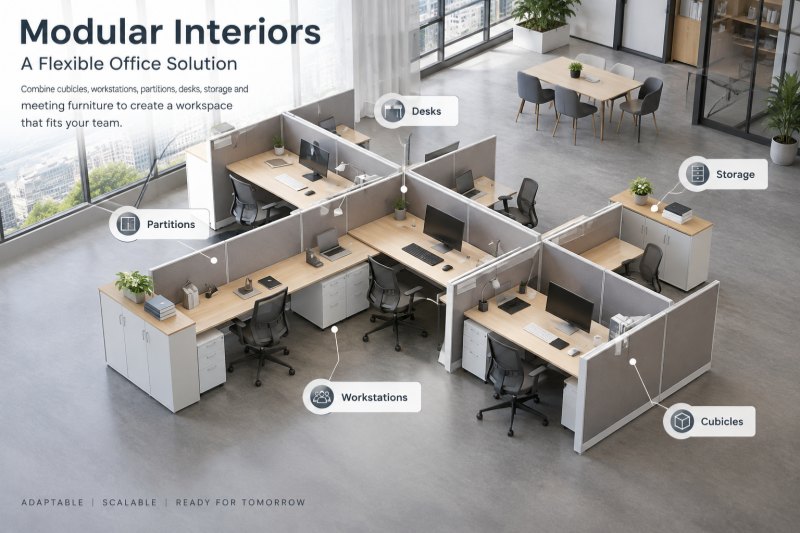
Modular interiors just means your office furniture isn't bolted down — office cubicles, office workstations, partitions, office desks, office storage, all of it can be rearranged as things change.
Office cubicles are usually the core piece. Desktop, partition, frame, storage module — put those together and you get anything from a single workstation to a 6-person (or bigger) setup.
The real point of building this way is flexibility. Say you've got 20 people now and hire another 10 next year — you're not tearing out the old furniture and starting over. Add a few desktops, a couple more partitions, maybe another storage module, and the layout stretches to fit.
That's really the difference between modular and traditional office furniture. It's not just desks pushed next to each other — it's a system built to move with the team, and cubicles are usually where that starts.
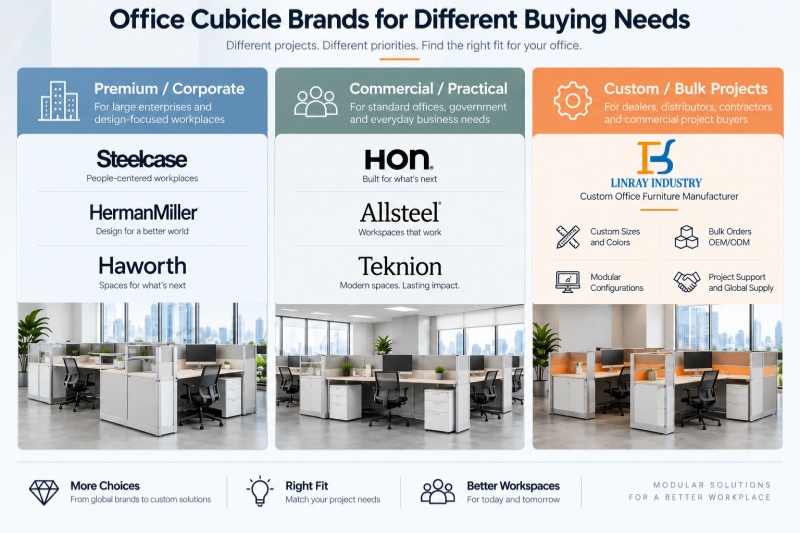
There's no single "best" cubicle brand. It comes down to who's buying and what the project needs — some brands are built for big corporate offices, some care more about design, and a few are set up specifically for dealers and bulk project orders.
Here are a few names worth knowing if you're shopping cubicles, workstations, or modular systems. What actually fits you depends on your layout, how much privacy you need, order volume, budget, and whether the setup needs to change later.
Steelcase shows up a lot in large corporate offices and projects that want everything working as one system. Their panel lines, Answer and Montage, come in different heights so you can add privacy without losing the ability to run power and data through the same desks. Departments grow, teams get moved around, and Steelcase's systems handle that kind of change reasonably well. You'll see them at a lot of corporate headquarters.
For companies that care as much about how the office looks as how it works, this is usually the first name people bring up. Action Office, Canvas Office Landscape, and Layout Studio all combine worksurfaces, screens, and storage in different ways depending on whether you need individual desks, team pods, or a fully open floor. Action Office is built around panels and parts you rearrange yourself. Layout Studio goes the open-benching route and scales with headcount pretty easily. If design is part of the conversation and not just cubicles, this is where to start looking.
Haworth's systems feel more complete than most. Compose pulls workstations, desks, storage, and screens together into one setup, and Compose Connections lets you slide tables, storage, and screens along a shared spine as things change. This one's built for offices that rearrange teams often — not a few standalone cubicles, but a system meant to move.
HON stays practical. Commercial offices, government buildings, regular corporate spaces — that's where it lives. The current lineup is Abound, Accelerate, and Verse, and panels, worksurfaces, and storage can be built into individual desks, L-shapes, or multi-person setups. Accelerate comes in a few panel heights and has acoustic panel options too, which helps if you want some privacy without fully boxing people in. Good middle ground if durability and everyday function matter more than making a design statement.
Allsteel covers desking, benching, panels, and private offices. Their panel systems — Fit, Optimize, Stride, Terrace — combine worksurfaces, storage, and power/data management across different layouts. Terrace can swing between open and more private just by changing panel height. Fit runs lighter but still handles desking, storage, and cable management. Makes sense for projects planning out several departments at once instead of buying cubicles one at a time.
Teknion goes beyond workstations into storage, partitions, and full architectural interiors, so it fits naturally into a modern modular setup. District combines desks, cabinets, windows, and walls into one system. Interpret uses parts you can reconfigure for different workstations. Boulevard is a panel system that's relatively painless to install and reinstall. The point is everything lives in the same space plan instead of getting bought piece by piece.
LINRAY is a leading modular interiors company for office cubicles. LINRAY works differently than the brands above. It's built for office furniture dealers, distributors, contractors, and commercial project buyers who need bulk orders and custom builds, not retail cubicles off a shelf.
Cubicles here can be configured as 2-, 4-, 6-person, or larger setups, with desktop sizing, panel height, colors, and finishes adjusted to the project. Desks, partitions, and storage combine however the project needs.
That flexibility matters more than it sounds like for dealers and project buyers — no two office spaces are quite the same size, and sometimes a standard product works, sometimes it's just slightly off. Office furniture doesn't forgive "close enough." If you're after custom cubicles, OEM/ODM, bulk orders, or modular configurations, going straight to a manufacturer like LINRAY makes more sense than sourcing from a retail brand.
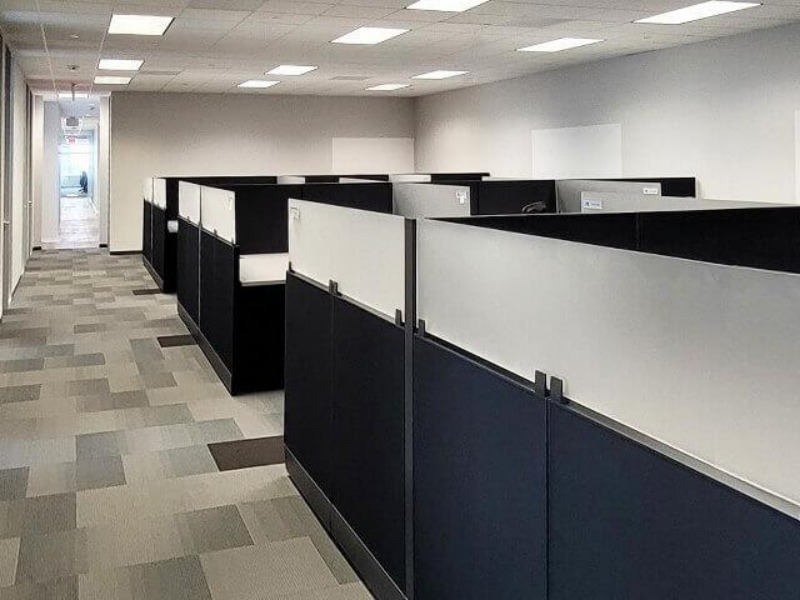
Low-panel, high-panel, multi-person, L-shaped, cubicles with built-in storage — those are the usual categories you'll come across.
Which one you actually need depends on how people work, not which one looks nicest in a catalog. A sales team that's constantly talking needs something different from someone doing quiet paperwork all day, and if someone's running two or three monitors, a small desk just isn't going to cut it. Figure out desk space, privacy, and whether headcount's likely to change before you start comparing panel colors.
These use shorter partitions — enough to mark off each desk without closing the room in. Heads down, you've got your own space. Look up, and you can still chat with whoever's next to you.
Sales, design, marketing — teams that talk a lot during the day tend to like this. It's also a decent middle ground if a fully open floor feels like too much but you don't want walls either.
Taller partitions here, mainly to cut down on people seeing each other constantly and give everyone a bit more of their own zone. Finance, admin, customer service — anywhere people need long stretches without interruption.
Worth a quick note: taller panels mostly block sightlines, not sound. If noise is actually the issue, that comes down to the panel material and how it's built, not just the height. So don't expect your office to suddenly go library-quiet just because the panels got taller. It'll still beat a wide-open layout for anyone who needs focus time, though.
This is just grouping desks together — two people facing each other or side by side, four for a small team, six (or more) once a department grows. Desks, partitions, frames, and storage usually come as one package rather than separate pieces.
The nice part is you're not buying a full setup for every single hire. A team of 4 starts with a 4-person layout, and if that system's built to expand, adding two more desks later is straightforward. Handy if your headcount moves around a lot.
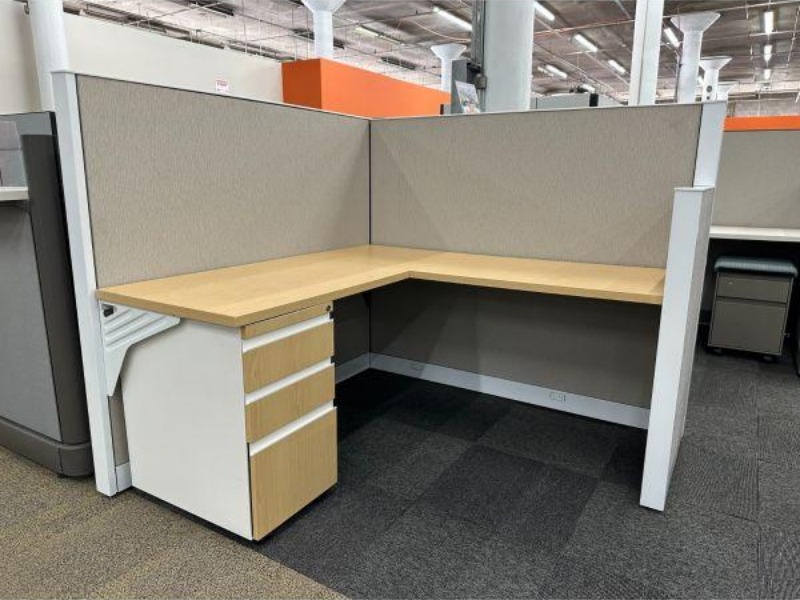
More desk space, basically — computer on one side, paperwork or a printer on the other. Good for anyone splitting time between screens and physical documents.
You can still bolt on panels, mobile pedestals, whatever storage makes sense, and line a few of these up in a row if needed.
One catch: bigger desks eat more floor space. Measure the room first, or you'll end up with people squeezing past each other just to get to their seat.
Filing cabinets, mobile pedestals, office cupboards, shelving — pick whatever matches what people actually use day to day. None of it needs its own dedicated corner; it tucks under the desk, beside it, or between stations.
Paper-heavy roles do fine with a filing cabinet close by. Personal items go in a pedestal. Cupboards handle the general stuff — folders, printer paper, supplies.
The bigger point with modular interiors is that none of this gets bought separately. Desks, partitions, storage — it's one system, built around how the space actually gets used.
Brand name and nice product photos don't tell you much. What actually matters is more boring stuff — how many desks fit your office, whether the cubicles can be customized, what happens with all the cables, where the storage goes, and whether you can add more later if the team grows. Boring, but it's what determines whether the purchase actually works out.
First question: how big is the office, and how many people are sitting in it. Two people, twenty people, two hundred people — none of those need the same layout. A small team might get by with a couple of 2- or 4-person setups. A bigger office has departments to account for, walkways, storage zones, and enough space between desks that people aren't bumping elbows.
This is where modular systems make sense. Desks, panels, and storage get arranged around your space and headcount — you're not stuck squeezing the whole office into one fixed cubicle size.
Before calling a supplier, it helps to already have your square footage, headcount, and a rough floor plan sorted out. Gives them something to actually work with instead of guessing.
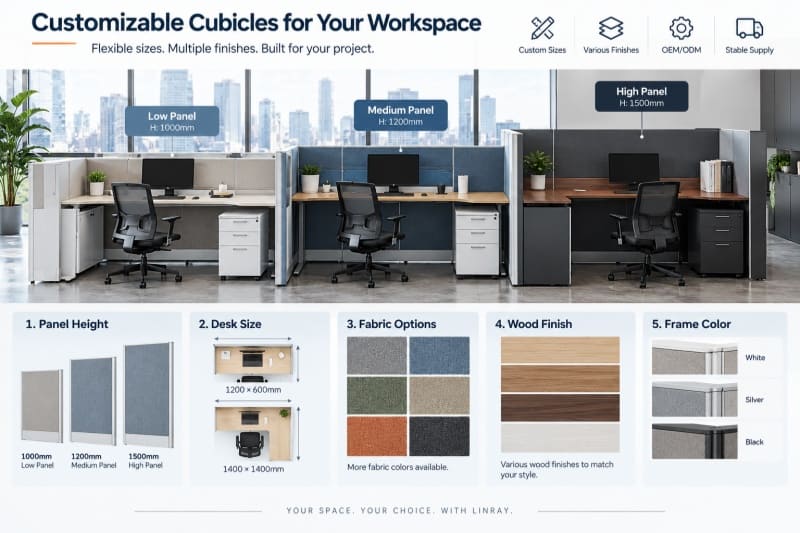
Offices come in different sizes, so customization actually matters here. A decent custom setup lets you adjust desk size, panel height, fabric, wood finish, and frame color — not just pick a different paint color and call it a day.
Want people talking to each other easily? Lower panels. Finance or customer service needing more privacy? Go taller.
This gets more important the bigger the order. Ordering dozens or hundreds of workstations, one standard size almost never fits every department. So it's worth asking exactly what can change before assuming "custom" means custom — ten fabric colors doesn't help much if the dimensions are locked.
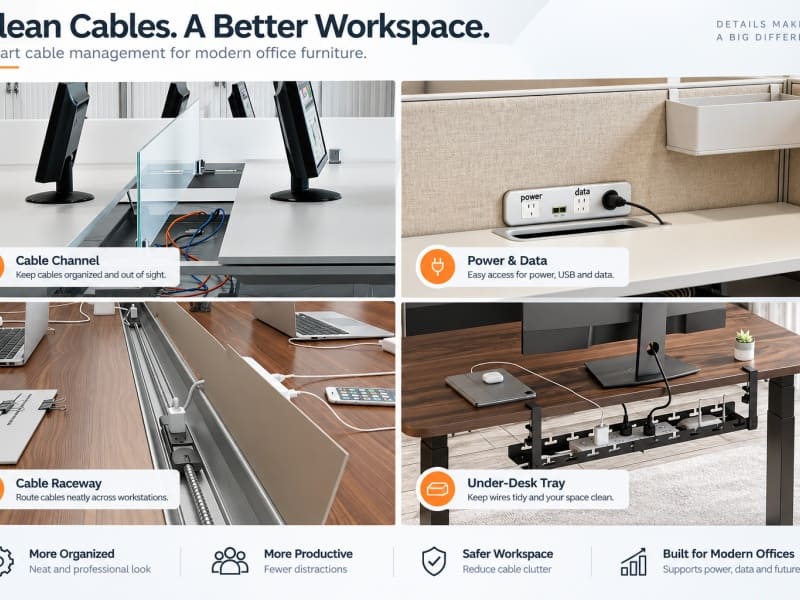
Nobody thinks about cables until people are actually sitting at the desks. Computers, monitors, phones, power strips — it all needs somewhere to go, and if nobody planned for it, the desk looks fine on top while everything underneath turns into a tangle.
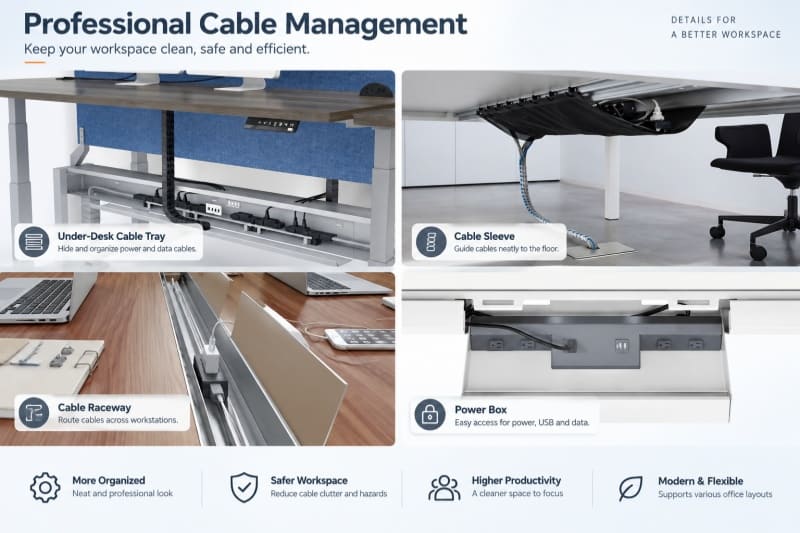
Worth checking whether cables route through the desktop, frame, panels, or a tray, and whether that still works once people add more gear later. Multiply that mess across dozens or hundreds of desks and it's not just an eyesore — it slows down installation and makes day-to-day use annoying.
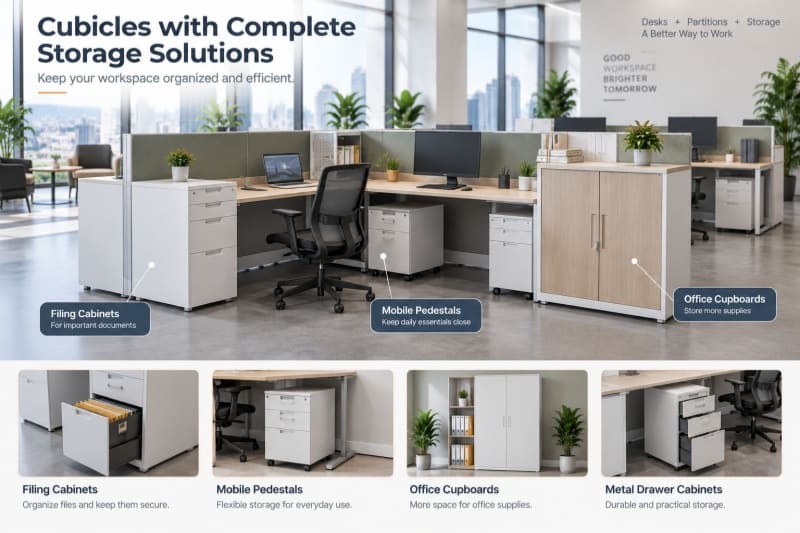
People need somewhere for files and supplies, not just a laptop spot. A solid modular setup should work with filing cabinets, mobile pedestals, cupboards, metal drawer units — whatever fits the job.
Filing cabinet near anyone handling a lot of paper. Pedestal for personal stuff. Cupboard for printer paper and folders. Plan the storage alongside the desks from the start, instead of finishing the install and realizing there's nowhere left to put a filing cabinet.
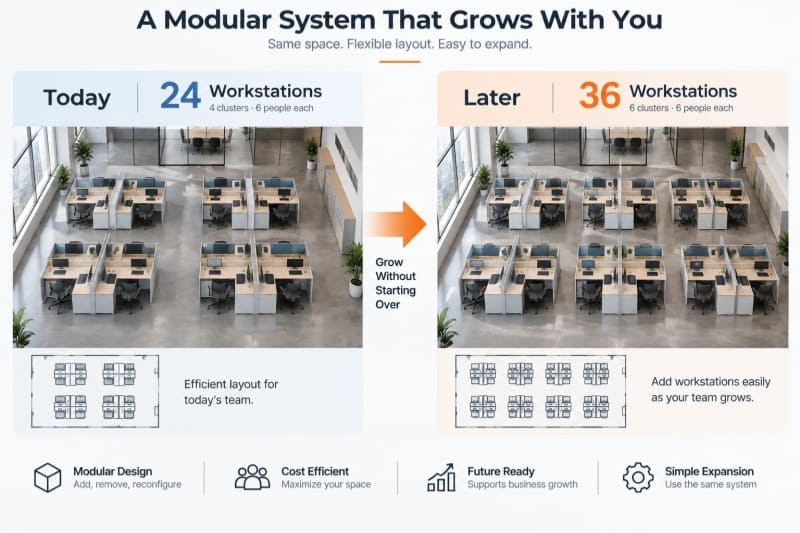
Last thing to check: can you actually add to it later?
Say a company's got 24 people and buys 24 workstations. Six months on, headcount's at 36. If the system's genuinely modular, you add desks and panels and rework the layout. If it isn't, adding 12 people might mean more than just ordering a few extra desks.
Worth asking the supplier directly — can workstations be added later, can panels be rearranged, can storage move, will the old pieces still work with new ones. A good modular system isn't judged by how clean it looks on install day. It's judged by whether it still holds up once the headcount changes.
There's no fixed price on modular office cubicles.
A basic desk with a low partition and a full workstation with high panels, storage, and a power system are technically both "cubicles," but the price gap between them can be huge. So when you're comparing costs, asking "how much per cubicle" usually doesn't get you very far.
What actually drives the price is size, panel height, materials, storage, electrical setup, order quantity, customization, and shipping.
Start with size — how big, and how many people. A single desk, a 2-person setup, 4-person, 6-person — each uses a different amount of desking, panels, frames, and other parts, so the cost shifts accordingly.
L-shaped cubicles or anything with a bigger worksurface uses more material, which usually puts it above a straight, simple layout in price. Best to nail down headcount and rough layout before comparing quotes.
Panels matter a lot here too. Low panels use less material, high panels need bigger partitions, and if the project calls for fabric panels, glass, special finishes, or acoustic material, the cost moves again.
If privacy or noise reduction is the priority, panel height alone doesn't tell the whole story — the material inside matters just as much. Two partitions that look about the same height can have completely different internal builds, and the price reflects that.
Mobile pedestals, filing cabinets, shelving — any of that gets added to the total. Same with power and cable management.
A plain desk-and-panel setup and a system with power modules, outlets, cable trays, and data management aren't really comparable on a flat "per workstation" basis. Worth confirming exactly what's included in a quote before assuming it covers everything — otherwise the first number looks cheap, then storage gets added, power gets added, a few extra parts get added, and suddenly the math looks nothing like the original quote.
Customization changes the price too. Standard size, standard color — that's usually straightforward to produce. Ask for custom desk sizes, panel heights, fabric, wood finish, or frame color, and the supplier has to reconfirm materials and production for that specific project.
Order quantity matters just as much. A commercial project ordering dozens or hundreds of workstations runs through production, packaging, and shipping differently than someone buying a handful of cubicles. For larger projects, it's better to give a supplier the actual quantity and customization needs upfront rather than just asking what one cubicle costs.
Don't forget shipping. Modular furniture ships as a lot of separate components, so packaging, shipping volume, destination, and installation all factor into the final cost.
This matters even more on international orders — the product price is only part of it. Packaging, sea or land freight, and how everything gets installed once it lands on site all add up too.
Honestly it comes down to a few things — how big the project is, what the budget looks like, the office layout, and how much customization you actually need.
Big corporate HQ, high-end office building, the kind of project where brand and design matter as much as function — that's usually where Steelcase, Herman Miller, or Haworth end up on the shortlist. They're not just selling desks with panels around them. It's the whole package — workstations, panel systems, storage, all built to work together across whatever layout you're running.
Most offices don't need that though. For a regular commercial space, the questions that actually matter are a lot more boring: does it fit the room, is the panel height right, is there enough storage, does the cable management actually work, and can you live with the budget and lead time. Sort those out and you've got a system that works day to day — nobody's picking a brand off a logo.
Now if you're a dealer, distributor, or contractor buying 50 or 200 workstations at once, standard catalog stuff usually falls short somewhere. Every project ends up needing a slightly different desk size, panel height, color, whatever — and some clients flat out need custom builds, OEM/ODM, or bulk orders that don't fit a normal product line.
That's when it makes more sense to just go straight to a manufacturer. LINRAY's a good example — they work mainly with dealers, distributors, contractors, and project buyers, building out 2-, 4-, 6-person or bigger setups and adjusting desk size, panel height, color, finish, and storage based on whatever the project actually calls for.

