Blogs

2026-09-29
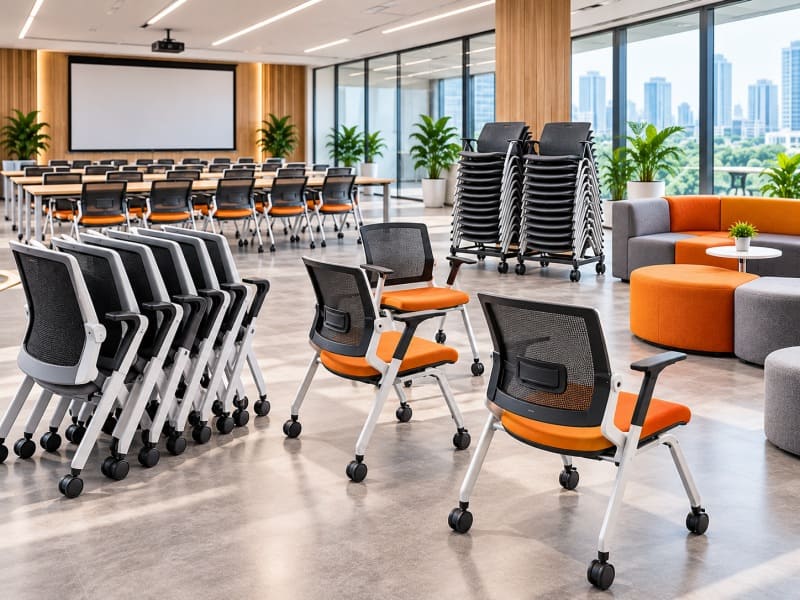
If your office rearranges seating often, four types are worth considering: nesting chairs, stacking chairs, mobile chairs, and modular lounge seating.
What they all have in common is simple — they're easy to move, and easy to put away.
Take a training room that needs rows of seats in the morning and small group clusters by the afternoon. Or a multipurpose room that might need 40 chairs one day and a completely empty floor the next.
In cases like these, comfort still matters — but how easily a chair moves and stores away matters just as much.
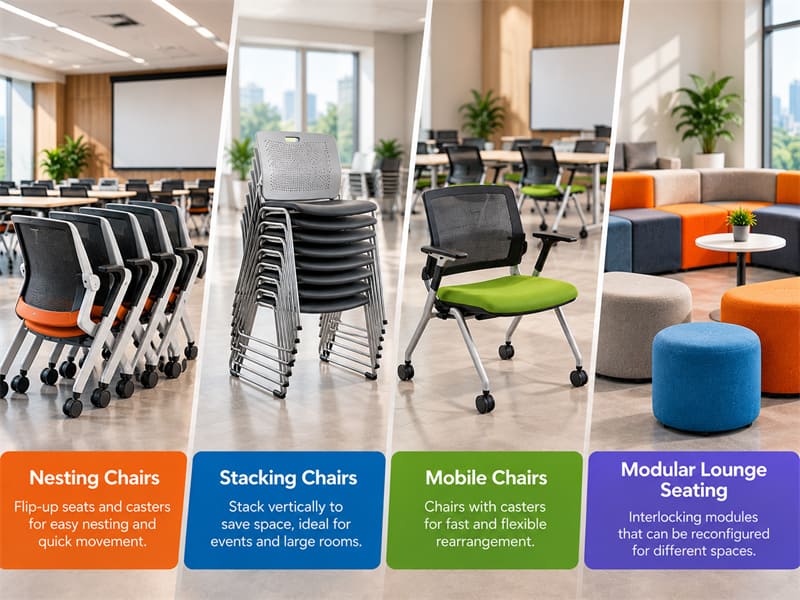
Different chair types suit different ways of using a room.
| Chair Type | Best For | Storage Mechanism | Reconfiguration Speed |
| Mobile Nesting Chairs | Training rooms, multi-use boardrooms, and dynamic classrooms | Flip-up seats that pack horizontally like shopping carts | Fastest (can be rolled away in groups by a single person) |
| High-Density Stacking Chairs | Auditoriums, large event halls, and breakout zones | Vertical stacking (up to 30–40 chairs high on a dedicated dolly) | Moderate (requires physical lifting but saves the most floor space) |
| Modular Lounge Seating | Informal collaboration hubs, office lounges, and reception areas | Interlocking geometric blocks or free-standing puzzle shapes | Fast (can be pushed into new geometric layout clusters) |
If you're rearranging seating often, nesting chairs are usually the more convenient pick.
Most nesting training chairs pair a flip-up seat with casters. When they're not in use, the seat folds up and the chairs slide together horizontally, one behind the next.
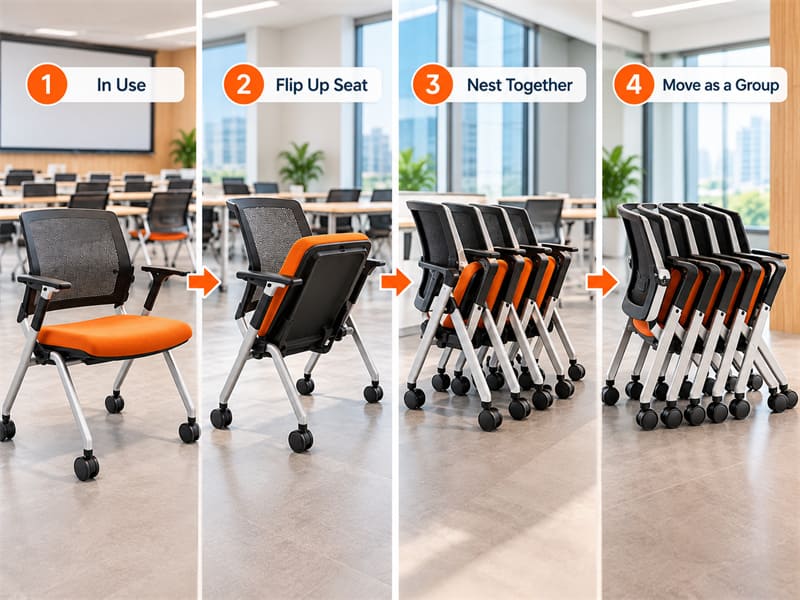
Compared to standard chairs, the real advantage here is how easy they are to move. If a room goes from a classroom layout in the morning to small group discussions in the afternoon, you can push several chairs together at once and reposition them without lifting a thing.
That makes mobile nesting chairs a good fit for:
- Training rooms
- Multipurpose meeting rooms
- Classrooms
- Conference rooms
If a room needs to change layout several times a week, your staff will thank you for not buying a set of heavy chairs that each have to be carried one by one.
Stacking chairs are the better fit when you need to get chairs completely out of the way.
When they're not in use, chairs stack vertically and take up very little floor space. Many commercial stacking chairs also work with a chair trolley, so you can move a whole set at once instead of one at a time.
You'll typically find them in:
- Training rooms
- Auditoriums
- Classrooms
- Event spaces
- Multipurpose rooms
The main difference from nesting chairs comes down to direction — nesting chairs slide together side by side, while stacking chairs pile upward. So if storage space is your main concern, stackable chairs are usually the better choice.
Sometimes you don't need to put chairs away at all — you just need to move them from one spot to another.
That's where chairs with casters come in. Staff can roll them into position without lifting anything. After a training session, for instance, chairs on casters make it easy to turn rows facing the podium into a few small discussion groups in no time.
One thing worth checking before you buy, though: caster quality and stability. The wheels are there to make chairs easier to move — not to turn the office into a racetrack.
For lounges, breakout areas, or waiting areas, modular lounge seating is worth considering.
These are usually built from separate modules — you can use them on their own or connect them into bigger setups. For example:
Straight layout → L-shaped layout → U-shaped layout → Separate seating groups
Push the modules together when a team needs to talk things through, then pull them apart again when the space needs to open up.
Nesting and stacking chairs tend to get packed away every day — modular seating usually doesn't. What it's good at is reshaping itself for whatever's happening in the room, which is why it works well for informal collaboration and break areas.
These two names come up together a lot, but they're not used the same way.
If your seating needs to move and get rearranged often, nesting chairs are usually the better pick — flip the seat up, and several chairs can be pushed away together.
If your priority is fitting a large number of chairs into the smallest storage space, stacking chairs make more sense.
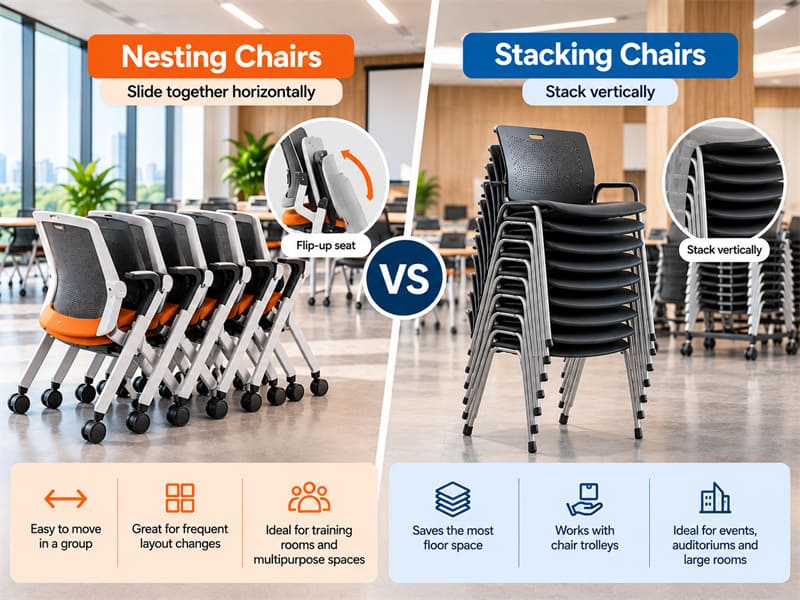
Simply put:
Change layouts often → Nesting Chairs
Clear the room often → Stacking Chairs
Neither one is "better" outright — it comes down to how the room actually gets used day to day.
When picking chairs for changing layouts, there are a few things worth paying attention to.
First is weight and how the chair moves. If chairs need to move often, extra weight just means more strain on whoever's carrying them.
Second is casters, flip-up seats, or a stacking design — these details directly affect how long it takes to rearrange the room.
Storage is worth thinking about too. Before buying, it helps to know where the chairs will go when they're not in use, and how many need to be stored at once.
Materials, color, and looks come last.
After all, a chair that looks great but needs two people to move every time the layout changes stops being so charming pretty fast.
What chairs are easiest to move for changing layouts?
Honestly, nesting chairs and anything on casters. You don't have to pick anything up — just push and go. That's why they're everywhere in training rooms and multipurpose spaces.
Are nesting chairs better than stacking chairs?
Not really "better," just different jobs. Nesting chairs win if you're rearranging all the time. Stacking chairs win if what you really need is to clear the floor and shove everything into a closet.
What chairs are best for a multipurpose room?
Any of the three — nesting, stacking, or mobile chairs — can work. Comes down to how often you're changing the layout and how much storage you actually have.

