Blogs

2026-09-08
A 20-minute meeting might not make much of a difference in the quality of a chair.
However, when a meeting becomes a two-hour discussion, training session, or team meeting, the comfort of the chair becomes apparent. A seat that's too hard will cause discomfort after a while. Insufficient back support will cause you to lean forward unconsciously. If the chair doesn't allow for any posture adjustment, sitting for extended periods will also lead to fatigue.
This is why when choosing stackable office chairs, you shouldn't only focus on whether they are easy to move and store.
Nestling chairs are designed for different scenarios. Their biggest advantage is their ease of adjustment; when the meeting room layout needs to be changed, they can be quickly rearranged. After training sessions, they can be neatly folded up, preventing the meeting room from being constantly filled with rows of chairs.
Therefore, if your office has meeting rooms and training rooms, nesting chairs are a very practical choice.
However, if meetings often last one or two hours, comfort cannot be ignored. After all, a chair not only needs to be easy to fold up, but the person sitting in it also needs to be comfortable. A good nesting chair needs a supportive seat cushion, a comfortable backrest design, and the ability to naturally adjust one's posture.
After all, it's important that chairs are neatly folded up after a meeting, but halfway through, people are probably more concerned about their back comfort.
So, what kind of nesting chair is suitable for long meetings? Next, we'll look at the details you should pay attention to when choosing one, including the seat cushion, backrest, materials, movement mechanism, and overall design.
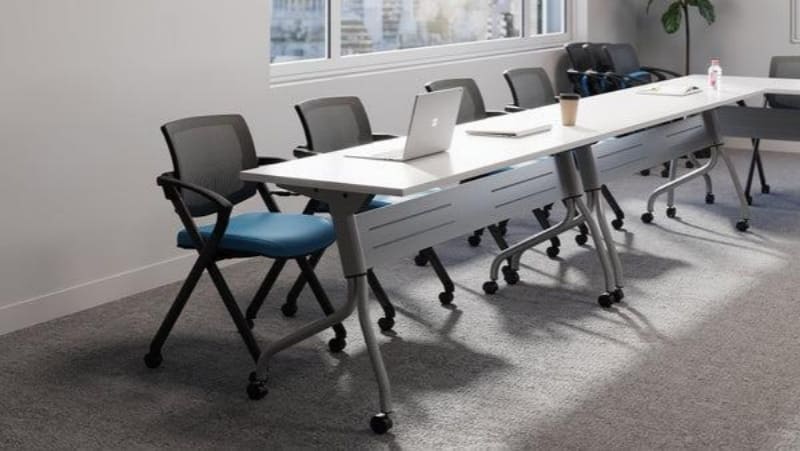
Yes, but comfort depends on the specific design of the nesting chair.
Many people's first reaction to nesting chairs might be: "These office chairs are mainly for easy movement and folding, right? They probably aren't very comfortable to sit in?"
This idea is actually quite common. Because nesting chairs are frequently found in meeting rooms and training rooms, people are more concerned with how quickly they can be rearranged and how much space they save after use.
However, not all nesting chairs are the same.
Some basic nesting chairs prioritize portability and storage, with a design focus on making them easier to move and store. If the seat cushion is relatively thin and the backrest is relatively upright, it might be fine for a short meeting.
But when you need to sit for an hour or two, or even longer, the differences in the chairs will gradually become apparent. Whether the seat cushion provides sufficient support, the comfort of the backrest, and whether the seating posture can be adjusted naturally—these small details will all affect your actual user experience.
For scenarios requiring extended use, office furniture stacking chairs typically incorporate more comfort-enhancing designs.
For example, a padded seat provides a better sitting experience, a flexible backrest offers support that adapts to body movements, while lumbar support and proper seat depth help maintain a more natural posture.
These design features may seem like small details, but the difference becomes increasingly apparent after sitting in a meeting room for an hour or two. A good nesting chair is not just about ease of movement and storage, but also about comfort.
Nesting chair ≠ Ergonomic task chair
While both are office chairs, they primarily address different problems.
Ergonomic office chairs are designed more for everyday office work. If employees need to sit in front of a computer for several hours a day, the chair usually needs to offer more adjustments, such as seat height, armrests, lumbar support, and posture adjustment, to help employees find a more comfortable sitting position.
Nesting chairs, on the other hand, emphasize flexible use. It needs to meet practical needs such as quick adjustment of meeting room layouts, multi-person use, and easy relocation and storage.
Therefore, a good nesting chair is not meant to completely replace an ergonomic office chair. Its advantage lies in its ease of movement and organization in locations where layouts frequently need to be changed, while also providing greater comfort for everyone.
If your meetings often last one or two hours, when choosing nesting chairs, don't just focus on whether they can be folded up or how much space they take up when folded. After all, the chair's value doesn't only lie in its folded-up state; it's the people who actually sit in it every day.
Whether the seat cushion provides sufficient support, whether the backrest conforms to the body, and whether the material is durable—these details all affect how people feel after sitting for several hours.
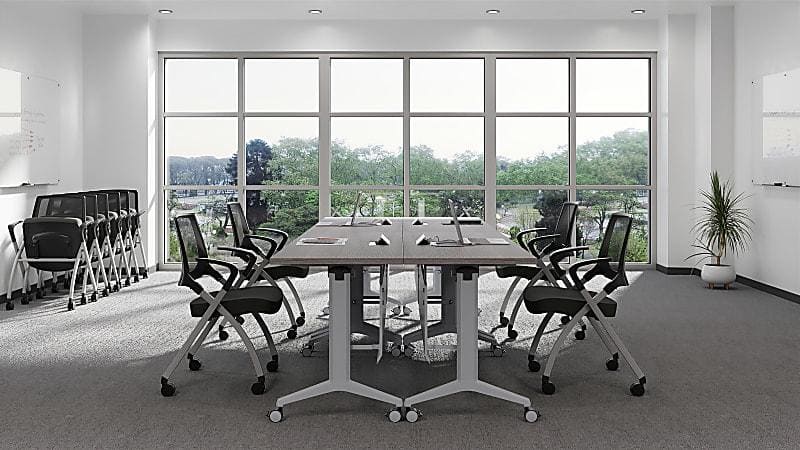
The comfort of a nesting chair isn't determined by its many features, but rather by a few small details that truly impact the user experience.
During long meetings, people don't maintain the same posture for extended periods. After a while, the body naturally adjusts, such as leaning back or shifting leg positions.
Therefore, a stackable office chair suitable for long-term use needs to strike a good balance between support, comfort, and flexibility. It should be easy to move and store, yet not cause excessive fatigue even after sitting for several hours.
Next, we'll look at several design details that directly affect seating comfort.
When sitting for extended periods, the backrest is a crucial factor affecting comfort.
Many ordinary chairs offer only basic support, which may not seem noticeable when first sitting. However, after prolonged sitting, the back will require a design that conforms to the body.
For example:
Especially during meetings or training sessions requiring continuous sitting, a supportive backrest is usually more suitable for extended use than a design that simply prioritizes lightweight design.
The seat cushion is the part that most directly affects seating comfort.
When you first sit down in a chair, you might not feel much difference. But sitting for 15 minutes and sitting for two hours feels completely different.
If the seat cushion is too thin, your body weight will be concentrated in a few pressure points, leading to fatigue after prolonged use.
Therefore, nesting chairs suitable for long meetings typically use:
However, a thicker seat cushion isn't always more comfortable.
More padding doesn't always mean more comfort.
A seat cushion that's too soft can cause your body to sink in, resulting in a lack of support. A good seat cushion should strike a balance between softness and support, making you comfortable without causing fatigue quickly.
Many people overlook seat size when choosing office or meeting chairs.
However, proper seat depth is crucial if you'll be sitting for extended periods.
If the seat is too short, your thighs won't receive sufficient support, leading to leg fatigue after prolonged sitting.
If the seat is too deep, especially for shorter individuals, your back may not be able to naturally rest against the backrest, and your lumbar region will lack proper support.
A chair that looks comfortable in a picture may not feel the same to everyone. Ultimately, a chair's suitability isn't determined by appearance alone; you need to sit for two hours to determine if it's comfortable.
Therefore, when choosing nesting chairs, in addition to considering appearance and function, you also need to consider your height, body type, and the duration of your daily sitting sessions.
People don't maintain the same posture for extended periods during meetings.
After sitting for a while, the body naturally adjusts, such as leaning back slightly, changing posture, or moving legs.
Therefore, some designs make nesting chairs more comfortable, such as:
These designs aren't meant to turn nesting chairs into office chairs, but rather to allow for small adjustments based on personal habits during long periods of sitting.
A completely fixed chair with no room for adjustment might be fine for short periods, but prolonged sitting can lead to stiffness.
The material also affects the comfort of a nesting chair, especially when used for several hours continuously.
Common choices include:
The biggest advantage of a mesh back design is breathability.
If the meeting room is frequently used, or the environment is warm, a mesh back can reduce the feeling of stuffiness in the back, making long periods of sitting more comfortable.
Upholstered designs usually provide a softer seating experience, while also looking more formal, suitable for occasions involving receiving clients or where you want the chair to coordinate with the office décor.
Neither design is inherently better or worse; it mainly depends on your specific needs.
If you prioritize breathability during extended sitting, consider a mesh back; if you value a soft seating experience and a formal appearance, an upholstered seat might be more suitable.
When choosing comfortable nesting chairs, it's not necessarily about pursuing the most features. More importantly, find a design that suits the duration of use, the number of users, and the actual environment.
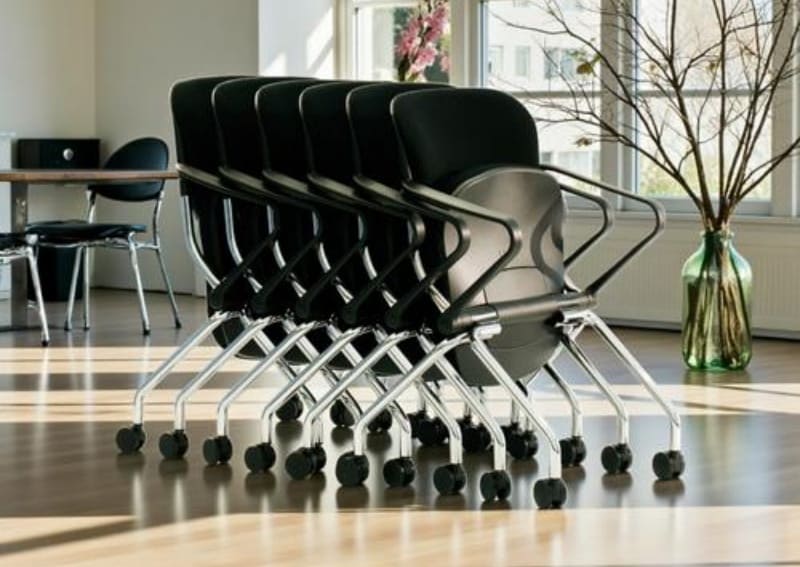
Different uses place different demands on nesting chairs.
If you need to conduct long training sessions for employees, you’ll likely prioritize comfort during extended sitting; if the chairs are mainly used for client meetings, you might focus more on whether they look professional; and if a room requires frequent rearrangement, portability and storage become more important.
So, when choosing a nesting chair, don’t just look for the model with the most features—first ask yourself: Who will be using this chair on a regular basis? How long will people typically sit in it? Will it need to be moved frequently?
Below, we’ll look at several common types of nesting chairs and the scenarios for which they’re best suited.
If you frequently hold lengthy meetings or the chairs see heavy daily use, mesh nesting chairs are a common choice.
The biggest advantage of the mesh back design is breathability. Even after sitting for a long time, your back won’t feel stuffy, and the flexible backrest provides support that adapts to your body’s movements.
If employees need to attend training sessions back-to-back or sit through meetings for several hours, breathability and back support are often more important than simply prioritizing aesthetics. After all, while it’s important for a chair to look nice, it’s not so great if you start feeling discomfort in your back halfway through sitting in it.
If your conference room frequently hosts clients or you want it to look more formal, upholstered nesting chairs are a good choice.
Upholstered seats typically provide a softer feel and are more comfortable to sit in. Additionally, the variety of colors and fabrics available allows them to better complement your office’s interior design.
They may not be the lightest option, but they strike a good balance between comfort, appearance, and practicality.
Simply put, while mesh nesting chairs prioritize breathability and flexibility, upholstered nesting chairs are better suited for spaces where you want the chairs to look more formal and feel more comfortable.
If you frequently need to rearrange the tables and chairs in your conference room, nesting chairs with casters are much more convenient.
With regular chairs, you usually have to move them one by one. With casters, you can simply push the chairs into place, eliminating the need for a “chair-moving marathon” every time you change the layout.
For example, the room might be used for employee training in the morning and converted for group discussions in the afternoon; in such cases, a chair that’s easy to move can save you a lot of time.
Of course, when choosing nesting chairs with casters, you should also pay attention to stability. While ease of movement is important, it’s equally important that the chair remains stable once you’re seated. After all, the chair’s purpose is to help you adjust your position, not to let you practice sliding around while seated.
The design featuring a writing tray provides a small space to place a notebook, documents, or a laptop without needing to set up an additional table. This is much more convenient for training sessions, classes, or any situation where you need to take notes while listening.
You can also pair them with training tables depending on your needs. If you need fixed seating, you can opt for a table-and-chair set; if you want more flexibility in the room, you can use nesting chairs with tablet arms, which are also easier to tidy up after the event.
Simply put, nesting chairs with tablet arms are better suited for training and learning spaces that require seating while still allowing for some flexibility.
When choosing meeting chairs, many buyers compare nesting chairs and stackable office chairs.
While both appear movable and foldable, seemingly just different things, their practical uses differ.
Stackable office chairs are better suited for situations requiring extensive chair storage. After an event, the chairs can be stacked and stored in a corner. In short, they are more like "quietly waiting, only to be deployed when needed."
Nesting chairs, on the other hand, are better suited for locations where chair and table arrangements frequently need to be rearranged. Many models come with casters, allowing for easy movement, and they can be neatly stored after use, eliminating the need for a "chair-moving exercise" every time a seating arrangement is needed.
If your priority is minimizing storage space, stackable chairs may be more suitable; if you frequently need to change seating arrangements, nesting chairs are more convenient.
| Feature | Nesting Chairs | Conference Chairs |
| Long-meeting comfort | Good with proper padding and back support | Usually very good |
| Easy to move | Excellent | Moderate |
| Space-saving | Excellent | Limited |
| Flexible room layouts | Excellent | Moderate |
| Easy storage | Excellent | Limited |
If your meeting room is consistently furnished and primarily used for formal meetings or client receptions, then conference chairs might be more suitable.
These chairs typically don't need frequent relocation; their primary focus is comfort and a more formal look. After all, the details like the tables and chairs create a strong first impression for clients.
However, if the same room serves different purposes—such as morning training, afternoon team discussions, or occasional seating rearrangements—nesting chairs are more convenient. You can quickly adjust to changes in the number of attendees, avoiding the need for a "chair-moving race" every time the layout changes.
Simply put, conference chairs are better suited for long-term, fixed use, while nesting chairs are better suited for locations that frequently require relocation.
There's no single right answer to which type to choose; the key is whether your chairs are primarily for casual use or need to be moved frequently with events.
When choosing nesting chairs, many buyers initially focus on appearance, price, or how much space the chairs take up when folded.
These are certainly important, but for business projects, a more crucial consideration is: how will this chair be used in daily life?
Consider these questions: What will this room primarily be used for? How long will a meeting typically last? How many people will typically use it? Will the chairs need to be moved frequently?
Therefore, understanding your usage habits before choosing nesting chairs is more reliable than simply looking at pictures and prices.
Different usage times require different nesting chairs. For simple 30-minute meetings, standard nesting chairs are usually sufficient. However, if the chairs are primarily used for training sessions lasting several hours, attention needs to be paid to details such as seat support, backrest comfort, and whether prolonged sitting will cause fatigue.
For example, training rooms often require employees to sit for several hours continuously; in this case, nesting chairs with better support designs would be more suitable. Otherwise, before the meeting is even over, everyone might already be secretly adjusting their posture.
When choosing nesting chairs, you also need to consider: Does this room frequently need to be rearranged?
If your meeting room often switches between training sessions, team discussions, and group activities, then a chair that is easy to move will save a lot of time.
In this case, casters, folding seats, and nesting designs become more important. They allow you to move and store chairs faster, without having to call several people to "relay" chairs every time you rearrange the room.
If you need to buy a lot of chairs at once, how much space they take up when folded is also a factor that cannot be ignored.
Looking at a single chair, you might not think there's much difference. But when dozens of chairs are stored together, the difference in storage space will gradually become apparent. After all, the number of chairs doesn't automatically decrease.
The advantage of nesting chairs is that they can be stored more compactly. After use, you can tidy up the chairs to keep the room neat and make it easier to rearrange them later.
Therefore, when choosing nesting chairs, don't just look at how nice a single chair is. You also need to consider: Who will use them? How long will they sit for at a time? How often will the room need rearranging? Is there enough storage space?
There is actually no single, fixed answer to this question.
Whether a nesting chair is suitable for sitting for several hours depends on various details—such as seat cushion thickness, backrest support, and seat dimensions—as well as the user's own height and body type.
For a short meeting lasting around 30 minutes, most nesting chairs will meet basic needs.
However, if you need employees to sit for extended meetings, you cannot simply focus on whether the chairs are movable or stackable. In that case, factors like seat cushion support, backrest comfort, and material breathability become much more important.
For instance, nesting chairs featuring padded seats, supportive backrests, and breathable materials are generally better suited for prolonged use.