Blogs

2026-09-09
If you are looking for a B2B office chair supplier in Asia, simply comparing price quotes is usually not enough.
For dealers, distributors, contractors, and clients requiring bulk office furniture purchases, price is certainly important, but other factors cannot be overlooked. These include consistent product quality, suitable Minimum Order Quantities (MOQs), customization options (such as color or configuration), lead times, and the ability to maintain the same specifications for future orders.
This is especially critical for long-term procurement: a sample chair that looks great doesn't guarantee that a shipment of hundreds or thousands of units will meet the same standard.
Therefore, when selecting an office chair supplier, you shouldn't just ask, "How much?" You also need to evaluate their product range, quality control, customization capabilities, production and delivery capacity, and experience with B2B export orders.
Below, we examine these practical procurement considerations to highlight the key factors to watch for when sourcing office chair suppliers in Asia.
If you need to purchase hundreds—or even more—office chairs, Asia is a market that is hard to overlook.
A very practical reason is the sheer variety of products available. From standard mesh office chairs and task chairs to executive, conference, and training chairs, you can find suppliers to match virtually any budget or configuration requirement. For dealers and distributors, this means you don't have to hunt for different sourcing channels just to acquire a few different chair series.
Additionally, many office chair manufacturers in Asia offer customization options based on your order.
For instance, with a specific chair model, you might want to change the mesh color, swap out armrests, bases, or casters, or even apply your own branding to the packaging. As long as the order volume is sufficient, these details can usually be negotiated with the supplier. If you are building your own brand, you can also discuss logo placement, packaging, and OEM/ODM services.
Price is, of course, a major reason why many clients source from Asia, but it shouldn't simply be reduced to the idea that "Asian chairs are cheap."
Bulk purchasing is fundamentally different from buying a few chairs at retail. Whether the order is for 100 units, 500 units, or a full container, suppliers will recalculate pricing based on the specific model, configuration, and quantity. For clients engaged in wholesale office chair distribution, this approach makes it easier to control procurement costs and facilitates future restocking.
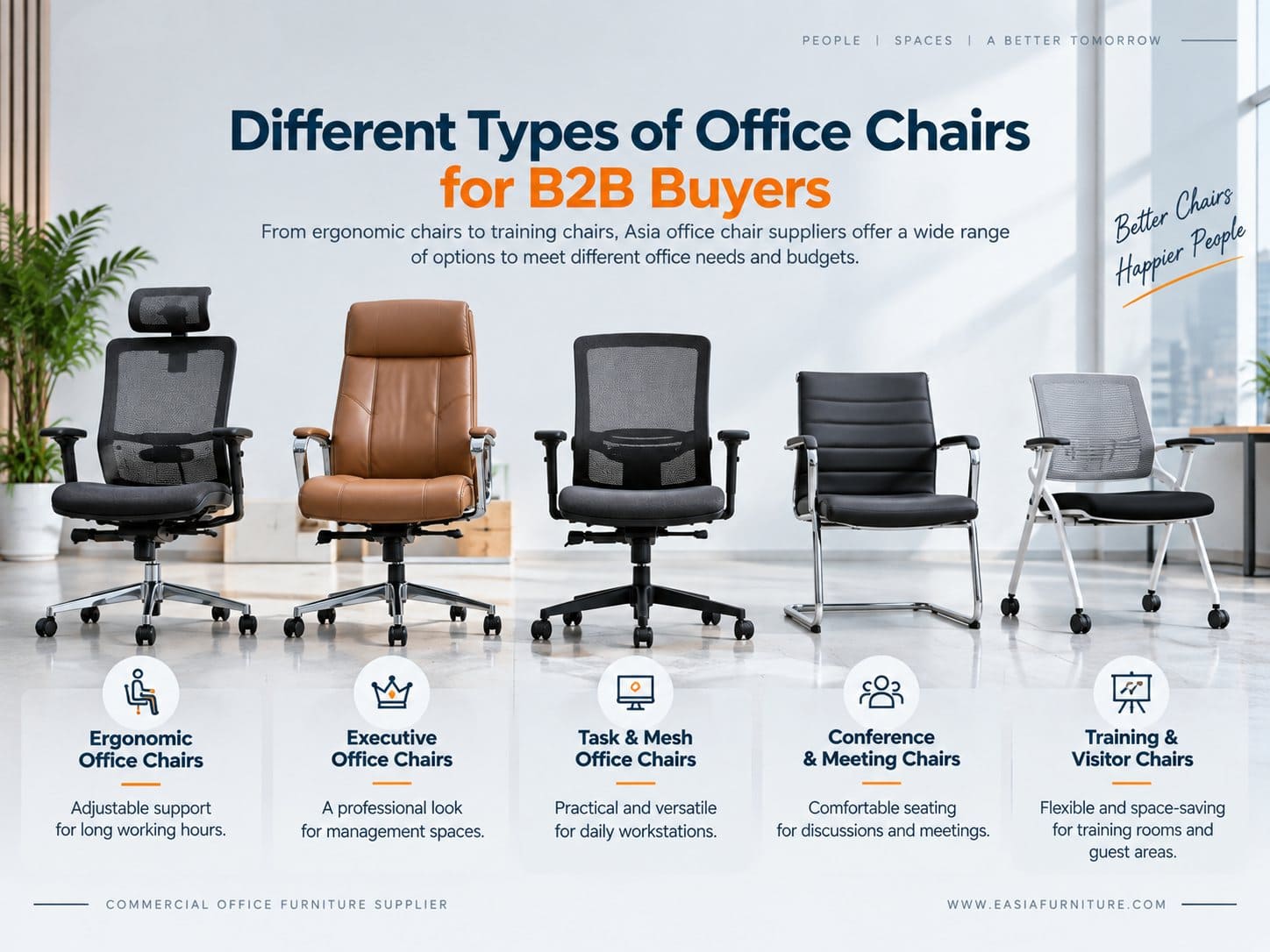
When purchasing office chairs, B2B buyers typically don’t buy just one type. Since the way chairs are used varies across different settings—such as for regular employees, management, conference rooms, and visitor areas, many office chair suppliers in Asia offer multiple product types to facilitate joint procurement by dealers, distributors, and project clients.
Ergonomic office chairs are better suited for employees who sit for long periods each day. Common features include adjustable lumbar support, headrests, adjustable armrests, and reclining mechanisms, allowing users to adjust their seating posture according to their needs.
These chairs are commonly found in corporate offices and workspace projects and are a staple in the inventory of many office furniture dealers.
Executive office chairs are primarily used in manager offices, executive suites, and other management work areas. Compared to standard task chairs, these chairs typically feature wider seats and backrests and more frequently incorporate leather, PU leather, or thicker cushioning.
For B2B procurement, in addition to appearance, it is important to pay attention to the mechanism, gas lift, base, and seat foam, as these components directly impact long-term usability.
Task chairs and mesh office chairs are commonly found in employee workstations, particularly in offices configured with dozens or even hundreds of workstations.
These chairs come in a wide variety of styles and price ranges, making them well-suited for wholesale office chair orders. When purchasing in large quantities, it’s best to confirm details such as the mesh, armrests, base, casters, and other configurations in advance to avoid discrepancies between the bulk shipment and the approved samples.
Conference chairs and meeting chairs are primarily used in conference rooms, meeting rooms, and other spaces for short-term discussions.
These chairs do not necessarily require as many adjustment features as ergonomic chairs, but comfort, ease of movement, and overall appearance remain important. For comprehensive office furniture projects, they are typically purchased alongside meeting tables or conference tables.
Training chairs generally prioritize mobility and storage; some models feature casters, folding seats, or writing tablets to allow training rooms to adjust their layout based on the number of attendees.
Visitor chairs are primarily used in reception areas, waiting areas, and for seating office visitors. For dealers and project buyers, these two product categories are often procured alongside other commercial office chairs, rather than being ordered individually in small quantities.
When choosing a B2B office chair supplier, price is just one factor. For dealers, distributors, and customers who make bulk purchases on a long-term basis, what matters more is whether the supplier can consistently deliver the same products in batches.
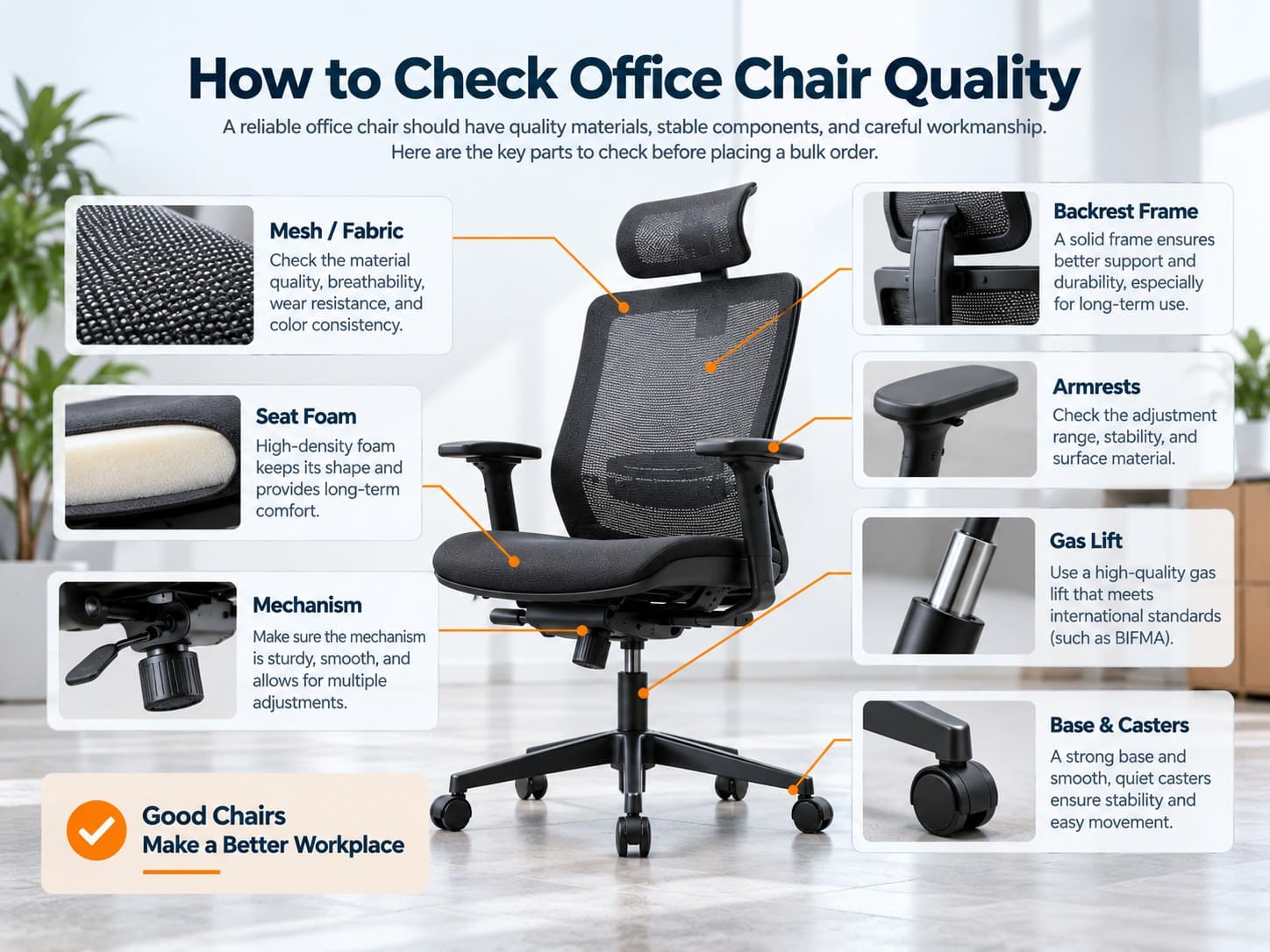
When evaluating the quality of an office chair, don’t just focus on whether it looks nice.
During the procurement process, you should further verify the mechanism, gas lift, base, casters, seat foam, mesh or fabric, as well as the materials and specifications of the chair frame. For example, what grade of gas lift is used, how much weight the base can support, whether the casters roll smoothly over the long term, and whether the foam will soften quickly after a period of use.
If possible, request a sample for inspection and testing. After all, no matter how attractive the photos of a sample may be, they cannot tell you what the chair will look like after an employee has been sitting in it for half a year.
If office chairs are to be used in commercial offices, government projects, schools, or other large-scale projects, clients may also have requirements regarding product testing and certification.
Before purchasing, it’s best to confirm which test reports or certifications the supplier can provide—such as BIFMA, SGS, CE, or RoHS—and which specific products these documents apply to.
Here’s an issue that’s easy to overlook: don’t just ask the supplier, “Do you have BIFMA?”—you should also confirm the specific models, components, or testing standards covered by the report. Seeing a certification logo doesn’t mean that all chairs have undergone the same testing.
There is no fixed MOQ for wholesale office chairs that applies to all suppliers.
Standard models are usually easier to arrange, but if you need to specify a mesh or fabric color, modify chair components, print a logo, or create custom packaging, the MOQ may vary.
Therefore, when requesting a quote, it’s best to provide the supplier with the product details, quantity, and customization requirements all at once. This way, the MOQ and price you receive will more closely reflect the actual conditions when placing an order, rather than getting a very low initial quote only to have the price recalculated every time you make a change.
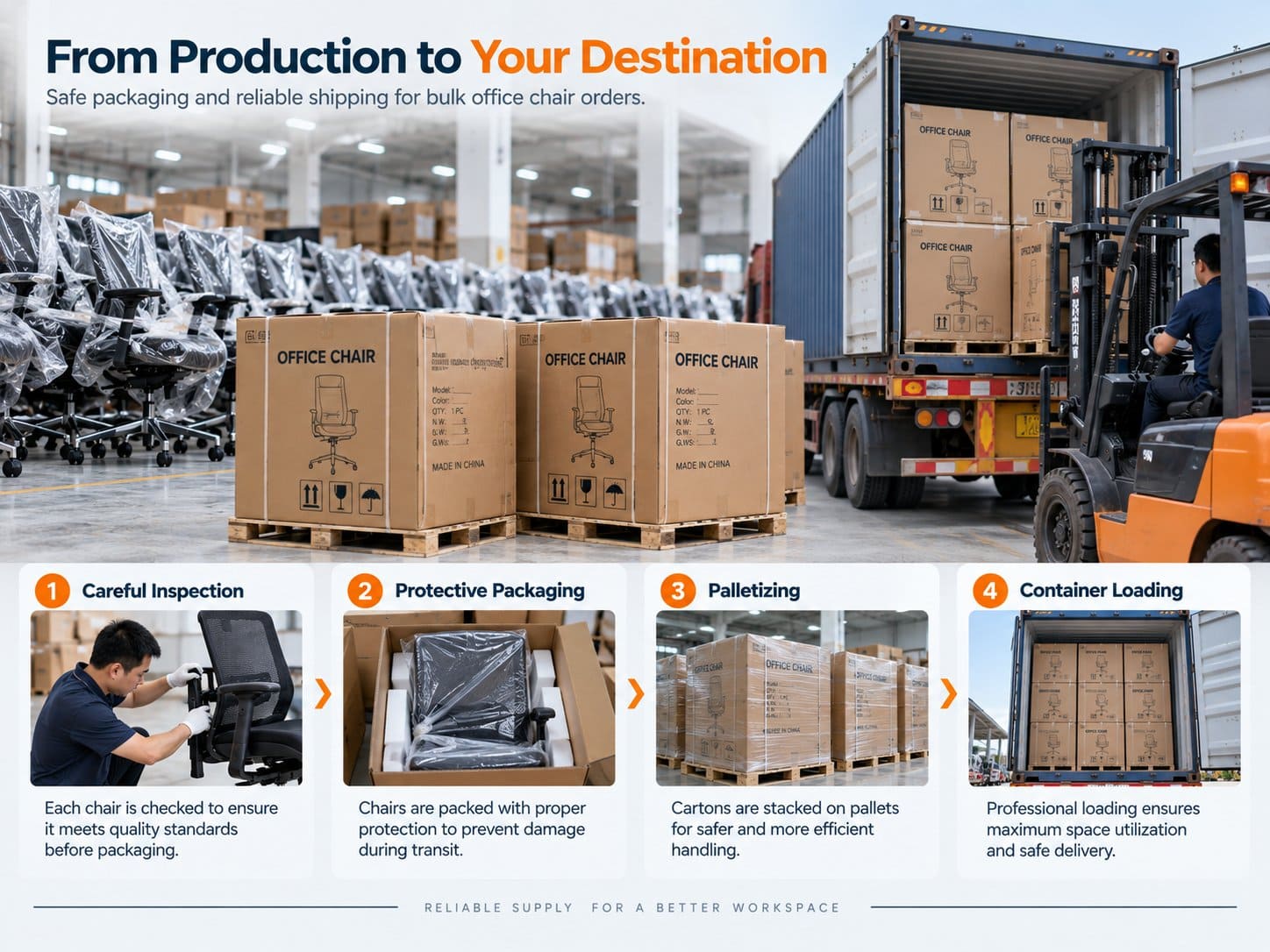
If you are a distributor, dealer, or run your own office furniture brand, OEM and ODM capabilities are particularly important.
Don’t just ask, “Do you support customization?”
Instead, confirm which components can be modified, such as the logo, fabric, mesh color, armrests, base, casters, packaging, and carton markings. If adjustments to the chair’s structure or configuration are needed, you should also confirm in advance whether new molds, samples, or additional MOQs will be required.
This is the only way to determine whether the supplier’s “customized office chair” truly allows for product adjustments tailored to your market, or if it merely involves changing the color of an existing chair.
For B2B buyers, production capacity isn’t simply a matter of how many square meters a factory covers or how many employees it has.
The more practical questions are: Can the supplier produce on time according to your order quantity? Will the same materials and specifications be available for your next repeat order? Will delivery times lengthen significantly during peak seasons?
When collaborating for the first time, it’s a good idea to inquire in advance about sample lead times, bulk production lead times, and the approximate production cycles for different order quantities.
For distributors, consistency is often more important than simply “working fast.” The first batch of 500 chairs may be fine, but when you order another 500 three months later, the color, accessories, and seating comfort should not feel like a completely different product.
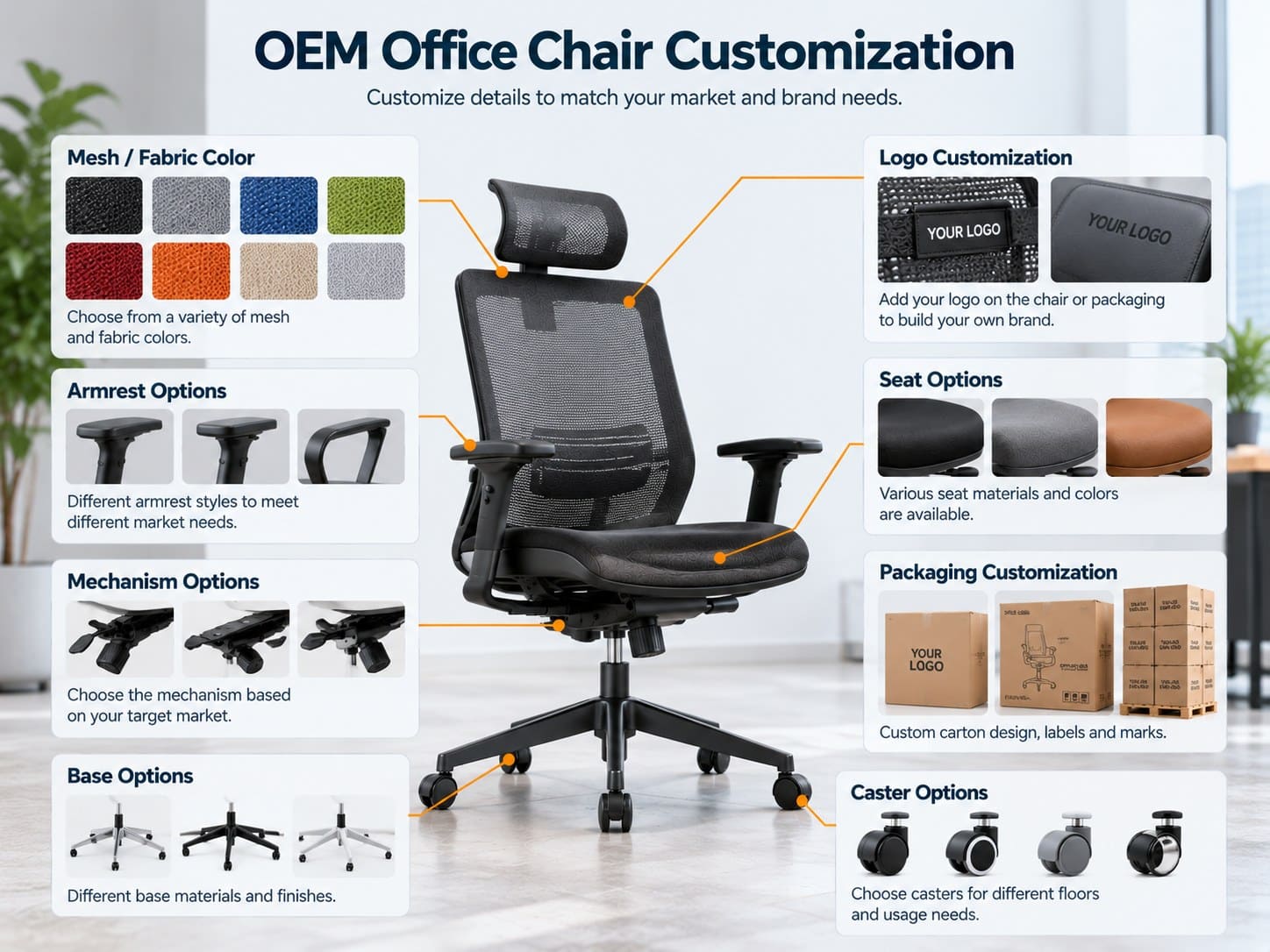
The order isn’t over once the office chairs are finished.
For export orders, you also need to consider packaging, carton markings, container loading, shipping documents, and shipment coordination. For full-container loads or office furniture projects, this may also involve mixing different models in the same container, calculating container capacity, and arranging delivery schedules.
It’s also worth clarifying after-sales support in advance. For example, if there are issues with casters, armrests, or other parts, can the supplier provide replacement parts, and will subsequent repeat orders still be able to use the same or compatible components?
These details may not seem as prominent as the chair price at first glance, but once a long-term partnership begins, it’s often these small matters that determine whether a supplier is easy to work with.
When looking for an office chair supplier in Asia, you’ll likely encounter two common types of suppliers: manufacturers and trading companies. Both models can handle B2B orders, but the main difference lies in your procurement approach and order requirements.
If you’re purchasing the same batch of office chairs on a long-term basis, or if you need to customize colors, fabrics, accessories, packaging, or other product specifications, working directly with a manufacturer is usually more convenient. Since the products are manufactured in a factory, communication regarding specific configurations—such as the mechanism, base, casters, and fabric—is more direct, and subsequent repeat orders can be produced more easily according to the previously confirmed specifications.
This is particularly important for large bulk orders. If you purchase 300 units initially and then place a follow-up order for 500 units, you’ll typically want both batches to be as consistent as possible—rather than discovering on the second order that a certain component has been changed.
Trading companies, on the other hand, offer different advantages. If your order volume is small but you wish to purchase many different types of products at once—such as office chairs, desks, storage cabinets, and other furniture—it can sometimes be more convenient to have a trading company consolidate products from different factories on your behalf. For small mixed orders, this procurement method may also offer greater flexibility.
Therefore, it’s not necessarily the case that a manufacturer is always better than a trading company.
If you prioritize repeat orders, OEM/ODM, product specifications, and bulk purchasing, you may want to consider working directly with an office chair manufacturer. If your order includes many different product categories with relatively small quantities of each, a trading company may be the more suitable choice.
When requesting a quote from an office chair supplier, simply sending a message like “Please send me your best price” usually makes it difficult to get an accurate quote.
For the same model of office chair, the price may vary depending on whether you’re purchasing 50 or 500 units; costs may also change if you select a different fabric, base, or packaging. Therefore, the more detailed the information you provide, the easier it is for the supplier to give you a price that closely matches the actual order.
When requesting a quote, it’s best to first specify the type of chair you need—such as an ergonomic chair, executive chair, mesh chair, or task chair—along with the approximate purchase quantity. If you’ve already decided on the material, color, or specific configuration, include that information as well.
If the products are intended for a specific country or for use in certain commercial projects, you should also specify the target market and required certifications in advance. This allows the supplier to confirm whether their existing products meet the requirements, rather than discovering at the time of shipment that relevant tests or documentation are missing.
For OEM or private label orders, you’ll also need to specify the logo, custom packaging, carton markings, and any other customization requirements. These details may affect the MOQ, unit price, and production lead time.
Finally, don’t forget to tell the supplier which country or port the goods are destined for, as well as the approximate delivery date. If shipping or container loading needs to be calculated, this information will also help ensure the quote is as comprehensive as possible.
A clear request for quotation doesn’t have to be long. For B2B office chair sourcing, clearly specifying at least the chair type, quantity, product requirements, customization, destination, and expected delivery time can usually significantly reduce the time spent on back-and-forth confirmations.
If you’re looking for an office chair supplier in Asia, you can also send these procurement requirements to Linray. Based on your quantity, product configuration, and target market, we can help identify suitable office chair options and provide a detailed quote.
If you’re looking for a long-term B2B office chair supplier in Asia, Linray primarily offers bulk purchasing services to office furniture dealers, distributors, contractors, and commercial furniture projects.
Our office chair product line includes ergonomic chairs, executive chairs, task chairs, mesh chairs, conference chairs, visitor chairs, and training chairs, designed to meet the diverse needs of employee workstations, executive offices, conference rooms, training rooms, and visitor areas.
To meet the procurement requirements of different markets, we also support OEM and ODM. Customers can customize configurations such as fabric, mesh color, armrests, base, casters, logo, and packaging based on specific products. For bulk orders, we arrange production after confirming samples and product specifications, and conduct quality inspections during production and shipping to ensure the final shipment aligns with the confirmed requirements.
Linray also has extensive experience handling export orders and can assist with packing, carton markings, container loading, and shipment arrangements. For dealers and distributors, follow-up repeat orders can be processed and produced based on previously confirmed product specifications.
Furthermore, Linray offers more than just office chairs. If customers need to purchase additional furniture for their office or a project, we can also provide office workstations, meeting tables, conference tables, training tables, reception desks, storage cabinets, and other commercial office furniture.
This way, when placing a complete office furniture order, there’s no need to source chairs from one supplier, tables from another, and cabinets from yet another—you can include all products in a single procurement plan for unified confirmation.